Chapter 2 of “Chö: Cutting Through the Thickets of Thinking”
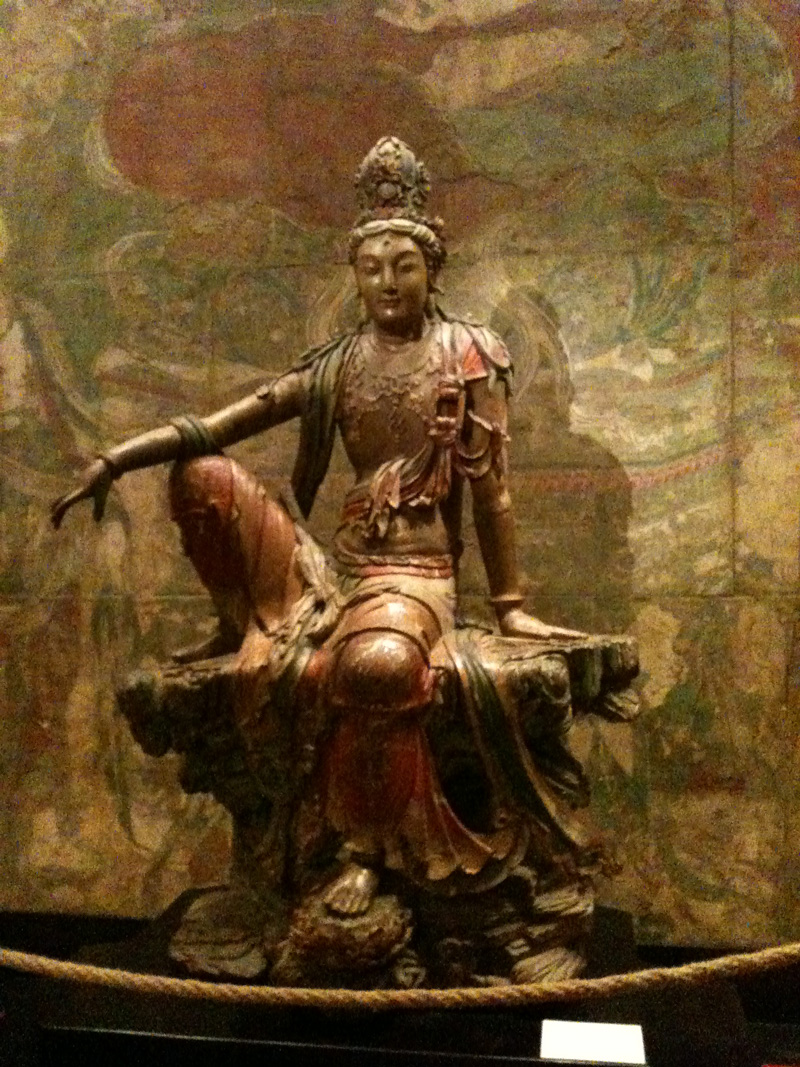
[…] is the Perfection of Wisdom, and difficult to see in this picture but like Avalokiteshvara she has four arms, and if I recall, two are joined in prayer, and one holds a rosary, and the other holds the Prajnaparamita, the text of the perfection of wisdom. And around her are all of the masters […]
Chapter 9 of “Pointing Out Instructions”
[…] a gloss. And a lot of people like the gloss because it makes it clear. So. Any other questions? We’re way over time. But it’s our last night. All done? You’re going to let me get away this free. Okay. Let’s just sit for ten minutes and we’ll do the dedication prayers at the end.
Chapter 6 of “Pointing Out Instructions”
[…] there. There are other contexts where I would very definitely make distinctions, but in this case I’m not making much distinction. If you turn to the Mahamudra Prayer: All experience is a manifestation of mind. As for mind, there is no mind; by its nature it’s empty. Empty and unrestricted, mind arises as experience. […]
Chapter 5 of “Mahayana Mind Training”
[…] for the last five or ten minutes of the meditation period. That’s a suggested sequence. Then at the end of the meditation period, we do the dedication prayers, and so forth. Okay? Applications of taking and sending Ken: Now, on page 17, we find the next point: applications. Now if what I have to […]
Chapter 9 of “Five Elements Five Dakinis”
[…] brocade, which is another set, were designed by a Chinese general to refresh his troops after long marches. That’s where they started from. But he used them. And they can be used for training energy for martial purposes. We use them for balancing techniques. They work very well. Okay? Let’s turn to the prayers then.
Chapter 5 of “Five Elements Five Dakinis”
The air element Ken: We have two more dakinis with which to develop relationship: the air dakini and the void dakini. And many people find these last two, particularly the void dakini, more difficult, and that’s quite understandable. Because when you are doing the business with the spheres, you notice that there’s less and less […]
Chapter 11 of “Mind Training in Seven Points”
[…] and recite the mantra, and they would not do anything else. If thoughts came through their head or emotions came, they would just sit there with their prayer wheel, mala, and do that. There would be absolutely no attempt to focus the mind or what have you. And that was very, very widespread. Their […]
Chapter 10 of “Mind Training in Seven Points”
[…] the Mahayana approach. I’m not sure really how widely this is practiced. It’s an instruction that I received from Kalu Rinpoche. And it’s the basis of a prayer service that he wrote for the evening rituals in his monastery. And basically it consists of all the steps that are outlined in The Great Path […]
Chapter 9 of “Mind Training in Seven Points”
The actual practice Ken: In the Mahamudra Prayer by Rangjung Dorje, one verse reads: Look at an object, there is no object: one sees mind; Look at mind, there is no mind: essence is empty; Look at both and dualistic fixation subsides on its own. Aspirations for Mahamudra This is the path of practice […]
Chapter 7 of “Mind Training in Seven Points”
[…] thun mtshams (pron. tün tsam). Thun refers to a session of formal meditation or formal practice. Where you sit down and you go through refuge, and lineage prayer, and refuge, and bodhichitta, sit for a period of time doing whatever practice, and then conclude. And then you get up. And thun mtshams refers to […]
Chapter 5 of “Mind Training in Seven Points”
[…] by aspiring to do that, you’re actually preparing the ground so that one day you’re able to do it. So in the Tibetan tradition, you have these prayers of aspiration which are absolutely mind-boggling in scope. You know? It’s said that Jamgön Kongtrül, who was a great teacher in the 19th century, is destined […]
Chapter 36 of “Then and Now: A Commentary on The Jewel Ornament of Liberation”
[…] Monks were dependent upon the laity for food, clothing, shelter, etc. So, you know, a monk might give a layperson a nice rosary or mala for saying prayers, or something like that, with the hope of getting some bigger donation later. Or, that’s one of the methods of wrong livelihood. So if you give […]
Chapter 28 of “Then and Now: A Commentary on The Jewel Ornament of Liberation”
[…] aren’t interested. That’s one of the characteristics of Buddhism: you only teach when it’s requested. We covered this another time when we were discussing the Seven Section Prayer. That’s actually, I think, quite an important aspect. Making an act of generosity more powerful Ken: Now then we get into this Increase section. This is […]
Chapter 18 of “Then and Now: A Commentary on The Jewel Ornament of Liberation”
[…] devoted their lives to this. And that has provided the avenue through which these teachings have been faithfully transmitted from generation to generation. And in that sense—a prayer that I used to say in retreat—the sangha is the foundation of the dharma, because it provides this avenue of transmission. So that’s the exoteric interpretation, […]
Chapter 5 of “Then and Now: A Commentary on The Jewel Ornament of Liberation”
[…] at the same time, another part of us knows that if we ignore this then we’re actually not living our life. Which, if we go to the prayers that we do at the beginning, then we find ourselves living a life in which we do know regret. It’s not a life free from regret. […]