Sutra Session: Being in the Experience of Life
In this Q&A session, Ken McLeod explores how Buddhist teachings and practices can be tested in experience rather than taken simply as beliefs. Through questions about karma, reincarnation, celibacy, meditation, and conflict, he considers how different practices function for different people and circumstances. He concludes by describing meditation as learning to be in the experience of life—to open to the totality of experience without distraction.
In the Buddhist tradition, a sutra refers to the meeting of the teacher’s mind and the student’s mind.
November 14, 2010
Karma as action, genesis, and result
Ken: Against the Stream. November 14th, 2010. Sutra Session.
Sometimes I come here and I have absolutely no idea what to talk about. I have a very simple remedy for that. So, where should we start today? Questions—everybody always has a question. That’s why you come here, because you have a question.
Student: I’d like you to talk a little bit about karma, if you would. I have trouble accepting the whole thing. I understand the conditionality of causes and effects, but the long-term business, especially the reincarnation—past lives, future lives—that’s something I’ve trouble with. Can you tell me how you have accepted that? And to what level? To what degree it’s based on your experience and to what degree it’s based on faith purely. [Laughter]
Ken: You make an enormous assumption in your question. Well, I can talk about this probably for a very long time, and probably much longer than you want, but let’s see. There’s a lot of misunderstanding about karma for many, many different reasons. And I’m not going into the reasons. I’m going to present a couple of ideas about that.
The first idea I’d like to present is that the whole notion of cause and effect is very inaccurate. It’s a Western way of looking at karma. It’s completely problematic, because in looking at karma in terms of cause and effect, you just wind up in a big mess.
The term in Tibetan is composed of three words: las (pron. lé with tone sliding down), rgyu (pron. gyu), and ‘bras (pron. dré with tone sliding down). Now las is the word for action. It’s the word for work, actually. And basically, the word karma means action.
The second word rgyu is usually translated by cause. But to my mind it’s a very inaccurate translation, because in English we simply don’t say that an acorn is the cause of an oak tree. I mean, if you’re a philosopher, you might say something like that, but most of us aren’t. And we use English more correctly than philosophers do. And so, an acorn isn’t the cause of an oak tree. It’s the genesis of an oak tree. That’s a very different thing.
And ‘bras is the word for fruit, literally it’s the word for fruit. And ‘bras is the word for apple and orange, and things. So it’s the result. And that’s what is usually translated as effect. So a better metaphor for karma than cause and effect, is this seed or genesis, which grows into something. And that’s a different picture right there.
We have to go a step further. In Eastern thought you have genesis, which is my translation of this word rgyu, and I can give you the Sanskrit for it if you’re interested. And then there’s another thing, and that is the conditions that allow something to grow, or prevent something from growing. So if I plant a carrot seed in the ground, and if that is just straight sand and there’s not anything, there’s no clay, or anything like that. And in particular, there’s no nutrients of any kind, and there’s no water. What’s going to happen to that carrot seed? Well, it’s just not going to do anything. It’s just going to sit there like a grain of sand. So even though there’s a genesis for a carrot there, no carrot comes out. There have to be the right conditions.
So when we’re talking about karma, we’re talking about a way of looking at how experience arises. In terms of certain experiences, there’s a genesis for them, and then there have to be the right conditions for those things to actually happen. And when I said earlier today, at the beginning of our meditation session, what we do in meditation is grow attention. One of the basic tenets of Buddhism is that we all have the genesis of attention in us. And by applying, or arranging the right conditions, which is sitting relatively straight and resting in the experience of breathing, we actually create the conditions for attention to grow in us. That’s karma.
Metaphors for karma
There are three metaphors for karma that I find useful. As my friend Stephen Batchelor says, “What’s the answer to everything in the East? It’s karma.” Which is to say, karma explains absolutely nothing, because it’s the answer that you give. Now, what was the answer that we used to give in the West, up to maybe at the very most 50 years ago, but really a hundred years ago? “It was God’s will.” You know, that’s how we related to things. Well, “It’s God’s will.” And if you’re a Muslim, you say, “Inshallah,” whatever.
There’s a wonderful story about Nasrudin, who’s my favorite Buddhist teacher. He goes to the tailor and he says, “Can you make me a suit?”
And the tailor said, “If it pleases Allah, yes.”
“Okay. Well, what do we do?”
“Well, I have to measure you.” He measures him.
“So, when will it be ready?”
“Well, if it pleases Allah next week.”
“And what if I need to have alterations?”
“If it pleases Allah, we speak to my assistant.”
And at this point, Nasrudin says, “Could we just leave Allah out of this, please?”
So, God’s will, Inshallah, karma, etc., these are all ways that were used to explain, or refer to things, that we couldn’t explain any other way. It was just to say: that’s a mystery; we don’t understand; we don’t know and we can’t know. So that’s one way that karma is used.
The second way, I’ve already referred to, it’s karma as evolution. Things evolve, they grow into other experiences, and so forth. And the third one is the law of gravity. Has anybody ever tried to repeal the law of gravity? We have the law of karma; in Eastern thought it’s viewed as how the universe works, a very, very deep principle. Now, you ask, how have I come to accept this?
One of my teachers was Dezhung Rinpoche. He died some years ago. Dezhung Rinpoche was really quite an extraordinary person. He was brought over to the West by the CIA—and lived in Seattle at the University of Washington—to provide resources. The CIA compiled a Tibetan-English dictionary, and things like that, to run insurgence in Tibet. He was one of the most profound and widely learned scholars of this last generation of Tibetan teachers, an incredible person. If you asked him a question you had to be prepared to sit there for two hours, because he was such an encyclopedia of knowledge. He was also an extremely warm person.
And one day, he was teaching a group of us, and he talked about his own teacher. And, how, when he was a young monk and studying, and because he was recognized as having special ability, he got special tutoring from this person. And as they were walking along, his teacher said to him, ” Oh, Dezhung-la, do you believe in karma?”
And Dezhung Rinpoche, being a young enthusiastic monk, and fully engaged in Buddhism said, “Oh, yes.”
And his teacher, who had spent years in retreat, working very, very deeply— who was himself an extraordinary person—said, “Oh God, you’re so lucky. I find it really hard.” And that really shook Dezhung Rinpoche.
Karma as story
Ken: Now what is karma in the end? Karma is a story. It’s a story that was made up to explain what was unexplainable. Why are some people horrible, mean people, and rich, and live long and healthy lives? Yeah, it really rubs us the wrong way. Why are some people who are just absolutely wonderful people, poor or ill, or just scraping by in life? It is not fair. And why are people cut down in the prime of their life? Why? I mean, all kinds of things happen and we have no explanation. And the answer is: karma. So it’s a story.
Now we in the West, we have our own stories, and we have a long history of chucking stories when they’re no longer convenient, or they no longer fit the way we look at the world. We had the Ptolemaic universe with all of these epicycles, and spheres within spheres, and things like that. And then Galileo saw the rings around Saturn, and so that story got chucked. Then there was the whole theory about diseases, which had to do with humours, and elements, and things like that. But then Pasteur came up with this idea that there were little squiggles called bacteria, and that story got chucked. And this is what we do in the West. We throw away stories when they no longer fit our experience.
Now I want to start in some totally other place. I find James Joyce completely unreadable, except for one book. A few of you have discussed this with me before, so you know. A Portrait of the Artist as a Young Man. This is his only readable book as far as I’m concerned. And at the end of the book he goes into a complete rant about how any religion which says you are damned to eternal hell before you’re even born is inhumanly cruel. This is towards the end of that book. So this is his reason for rejecting Catholicism.
Well, some time or other in my career in studying Buddhism, this whole business about a bus careens off a cliff and all of these school children are killed. Well, that’s their karma. They must have been murderers in a previous life. I don’t buy it. I’m sorry. That’s the story. But I think that is just as inhumanly cruel. I come back to this point. This is a story to explain what is inexplicable. I prefer to live in the mystery. Okay? You may have a follow up question.
Finding your own path
Student: Well, does that mean that you don’t fully accept the notion of reincarnation and it’s okay not to? [Laughter]
Ken: Oh, I’ve got to ask this question. What’s going to happen to you if you don’t accept reincarnation?
Student: Nothing’s going to happen to me. I just want to feel comfortable as somebody who follows Buddhism and not believing in reincarnation.
Ken: Sorry, I didn’t catch the last part there. You can feel comfortable. I didn’t hear—
Student: Identifying myself as a follower of Buddhism and not accepting certain things that are considered central by some people to this faith.
Ken: Well, they’re considered central by some people, yes. Okay. What inspires you about Buddhism? Why are you interested in this weird, esoteric thing from the East?
Student: Well, from experience, it has been very beneficial to me in terms of letting go of a lot of things, and living in a more peaceful and calm way, and relating to the world in a more realistic, truthful way.
Ken: Okay. So why, if you have that kind of benefit from it, would you burden yourself with a whole bunch of extra beliefs?
Student: I haven’t, but I come across them from time to time when I go to Buddhist talks.
Ken: Oh yes, yes, I know. And if you listen carefully, you will hear the sounds of me being drummed out of one Buddhist center after another. [Laughter] I gave a talk at a Buddhist center once. Somebody came up to me and said, “Well, if Buddhism had a concept of heresy, that would definitely fit.”
Look, there is this body of teaching that comes down to us, which is extraordinarily rich and multifaceted, which has been practiced for like 2,500 years. There’s a huge body of experience, and wisdom, learning, and understanding in it. And every single individual has had to find their own path. You take what is useful, in exactly the way that you’ve described, and you find your own path. And it’s very important, I think, that you do not let the social pressure, or peer pressure, or cultural pressure, lead you to believe something that doesn’t actually fit with you. Now, you may find at a certain point that something you’ve been holding, which is very important to you, you may find that that’s completely wrong. And then you let it go yourself. But that’s because it no longer makes sense to you.
And everybody loves quoting the Kalama Sutra, you know, just rely on your own understanding, etc., etc. But as Ajahn Amaro, a friend of mine, pointed out, everybody leaves out the second part of the Kalama Sutra, which says: “How do you discern what is true? By listening to those who have practiced etc., and seeing what they have said.” So you listen, you weigh it against your own experience, and you keep an open mind. But, absolutely, it has to make sense to you because it is your life, and your practice, and your path.
And there are many instances in my own experience, where I thought, okay, I understand this, and I wouldn’t listen to anybody and I would go that way. And at a certain point things would get really hard. And then I would find, oh, this can’t be true. It just doesn’t make any sense. I’d run into a brick wall, or actually, it was usually I dropped off a cliff. And then think, oh, there wasn’t any ground there after all. But it’s coming from your own experience then. And, make every effort to plumb the depths of your own experience. That’s very important. Don’t believe everything your own experience is telling you either. Does this help?
Student: Yes. Thank you.
Ken: You’re very welcome. It’s open question period. We’re just going round. You’re next.
Celibacy and intimacy
Student: Well, serve me right for going outside for a moment. My question is about the tradition of celibacy and sexuality in the context of Buddhism.
Ken: Okay, what’s the question?
Student: The question is, is the effort for traditional Buddhists to be celibate, a cop out vis-a-vis intimacy. Or an exploration of intimacy?
Ken: Well. You asked this as an attorney might ask a question. [Laughter]
Student: That’s funny; that’s what I am. [Laughter]
Ken: An attorney, when he has a witness on the stand, always wants to know what the answer is, right? And so, I’m not going to cooperate here. Because, the way that you’ve set this question up—this emphasis on celibacy as a cop out for intimacy—this is exactly on the lines of, “When did you stop beating your wife?” [Laughter] You follow? I could ask you to rephrase at this point. I’m not going to bother. The answer is no. However, having said no, and I say that unequivocally, was it used that way? Absolutely. But was that the point? No. And that differentiation is very, very important.
This is a very rich and actually quite complex subject. And there’s a lot of cultural stuff, not just Eastern cultural stuff, but I’m talking about the evolution of cultures wrapped up in it. Because, the importance of celibacy is not exclusive to Buddhism at all. It plays a very, very significant role in Christianity, Mount Athos, among others. It shows up in sports, and has shown up in sports very, very frequently, that men dissipate their energy through having sex. And there’s no scientific evidence for that. But this is a very, very deeply held view all over the place, not just within Eastern cultures.
When one is engaging in very deep spiritual practice, you are bringing all of your energy to that in the same way that a musician, or an artist, or an athlete, anything like that, is bringing all of their energy to that. Within esoteric religious practice—and again, I’m not limiting this to Buddhism—there are a number of traditions where very basic energies in the body, such as sex, are used as a basis for very powerful states of attention transforming experience. These aren’t for the ordinary practitioner, they’re quite dangerous and disruptive in a lot of ways. And the purpose of that is to have the most intimate relationship with life possible.
That’s why I say, unequivocally, that the point of celibacy wasn’t to avoid intimacy. It was to engage intimacy at the very, very deepest levels. However, has it been used within Christianity, within Buddhism, within other traditions, to avoid intimacy? Oh yeah, a lot. And that’s one of the problems. And they can be very, very serious problems.
Basically, from my perspective, each person has to find their own path. In the same way that I was referring to with the other gentleman, from my perspective there isn’t a prescribed path. For some people this is going to be the path that is most beneficial. That’s going to lead them in their relationship to life, to the most intimate experience possible. And for other people it’s going to be a different path. I know some of the teachers I’ve had, have been celibate. Some of them have been married. From my perspective there hasn’t been any plus or minus about that at all. And in the work that I do with students, I pay very, very close attention to what actually brings them into the fullness of their experience of life, whatever form that takes. Okay?
Thoughts are leaves, not bricks
Student: Thank you. In your instruction on meditation and the return, it seemed to suggest there’s an effort there to return. But with the distractions, what you do with the distraction? It doesn’t seem like there’s an effort to push them away. As you return to one thing, what do you do with the distractions essentially?
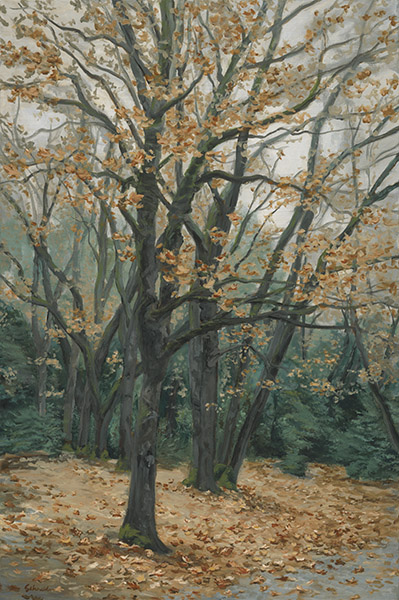
Ken: So it’s fall now, isn’t it? Now, we don’t do this very well in LA, but let’s pretend we’re back East. And in the fall, leaves fall from the trees. We have our Santa Ana winds. And the winds kick up, they swirl the leaves around, and they can be blowing all over the place. Right? And you go for a walk. You go for a walk with the wind and the leaves swirling all over the place. Is that a problem? Why not?
Student: It’ll pass. It’ll stop at some point, settle down.
Ken: Oh, you’re going for a long hike. And it’s a big blustery thing. The wind just goes on and on. Is it a problem?
Student: I guess it depends on the speed of the wind.
Ken: Well, that’s true, but it’s got all the leaves swirling around in it. You’re walking through and it just leaves all over the place. Are the leaves a problem?
Student: Shouldn’t be.
Ken: Why not?
Student: Because they’re not going to ultimately obstruct your walk.
Ken: Okay. So, you have a few thoughts while you meditate?
Student: Yes.
Ken: Okay. Are they like bricks or leaves?
Student: Leaves.
Ken: You still have a problem? [Laughter]
Student: Not in that regard.
Ken: But that’s the way to view it. Okay. Your thoughts are going to come up. Now, if you try to arrange everything just nice, and you start trying to catch all these leaves, then they become a big distraction. But here you are, oh, distracted. Oh, distracted. Oh, distracted again. Oh, distracted. That’s meditation. [Laughter]
Student: Thank you.
Ken: But that’s what it looks like. That’s why I say, you’re going to be distracted. I don’t even tell people to bother me about distractions until they’ve been distracted for a million times. But there always comes that moment of recognition. Oh, and then just come back to the breath. You don’t have to do anything with that stuff. It doesn’t matter whether it’s thoughts, or feelings, or sensations. You can just let it be there. You just go on with your meditation. And it comes up again, and pulls you off, and it comes back again. So return, rest, return. And that’s for the hiking analogy. That’s one step, one step, one step, one step. And the leaves go, and the wind blows, and the rain comes, and the sun comes out, and things like that. And at the end of the day, you’ve had a nice hike. Okay, Peter. I haven’t seen you for a century.
Peter: I don’t have any questions.
Ken: Oh, okay. Hand it to the person next to you.
Bringing in extra machinery
Student: I have a question. You mentioned at the beginning of the meditation session that you advise against counting the breath, like mentally.
Ken: No I didn’t.
Student: I thought you did.
Ken: I just said, “Forget everything you’ve heard about meditation.”
Student: You kind of mentioned that at a late stage it could bring up its own problems. I was wondering if you could elaborate more.
Ken: Yes, not counting the breath. Let me say a word about that too. When I said that focusing attention on the breath, as opposed, or in contrast to, resting in the experience of breathing, this preposition can make a very big difference. Pick up the microphone there. Now just put your attention on the mic. Okay. Everybody can do this. You just pick up any object that’s close to you. You can even use your hand if you don’t have anything handy, and put your attention on it. Okay. Now let that go. Take the object again. Now, rest in your experience of the object. [Pause]
What’s the difference? No difference at all? Well, if you’ll allow me to be really picky here. When we say on—I’m here, the object is there. So it creates a division, “I”/other. That’s the problem that comes back to bite later on. When we say rest in the experience of the object, that “I”/other isn’t being emphasized in the same way. And so one moves—going back to the comment over here—into a more intimate relationship with experience, which from my point of view is the whole point of the exercise.
Now, with respect to counting the breath. When we first start meditating, meditation can be like having a picnic with a herd of elephants. You sit down, you arrange everything, it’s all nice. And this herd of elephants moves in and there’s just not much left of your picnic. When I started meditating that was absolutely what it was like for me. I couldn’t maintain any continuity of attention whatsoever. Other people, they seemed to be able to do that. That’s fine, It was hopeless for me. So, some people are blown all over the place by their thoughts, and other people are blown all over the place by their emotions. And some people just go completely dull: meditation, just go to sleep.
So when you have these kinds of issues, and many people do, then you bring in a bit of extra machinery to help out. So one piece of extra machinery is counting the breath. One, two, three, four. Now, this helps because it gives you a bit more to hold on to, but it also creates a problem. You know what problem it creates? People make a contest out of it. How far can I get today?
There’s a wonderful story. A friend of mine told me about this Hungarian person who was studying at a Zen monastery. He was one of these people whose thoughts were just going all over the place. So his teacher said, “Count your breath up to ten and then start again.”
And the Hungarian came to this Zen teacher every day and said, “I can’t get up to ten. I always lose track before five.”
“Well, what do you do then?”
“Well, I start again at one.”
“Very good.”
“But I can’t get up to ten.”
And the Zen teacher said to a friend of mine, “I can’t understand what his problem is.” From the Hungarian’s point of view he wasn’t being successful unless he got to ten. But from the Zen teacher’s point of view, every time he lost track, he was starting again. That was the meditation practice and they never met. So don’t make a contest out of it, whether it’s 7 or 10 or 21. People like 21 because it’s a magical number being composed of 3 times 7, two prime numbers, etc. I mean, that’s why. Yes. And it doesn’t matter. You could choose 15 or 13. The point here is, just what the Zen teacher’s saying, “Whenever you’re distracted, start again.”
Now other people, they’ve just got emotions flying all over the place. And this counting business doesn’t work at all, it really doesn’t. For those kinds of people I like to use a meditation which I got from Thich Nhat Hanh. Now, when he first came out with his meditation, it was really wonderful, then he mucked it up later. So, I’m going to give you the original version: calm, smiling, present, now. As you breathe in, you say to yourself, calm. As you breathe out, you say to yourself, smiling. Now, it’s important, you don’t have to smile. You kind of feel a smile in your heart, and it brings a certain lightness, an emotional lightness, which is really helpful in meditation. And then as you breathe in again, present. And as you breathe out, now. And then you start again: calm, smiling, present, now, calm, smiling, present, now.
And I think this is absolutely wonderful meditation because it’s very simple. It’s like a simple mantra. It covers all the key points. And that constant calming quality helps people who are really being torn up by their emotional reactions and so forth. So, that’s what I give to people who have a lot of emotional stuff going on. People who are thinking too much, I give them the counting. Then there are the people who fall asleep, I tell them to walk. It’s really hard to fall asleep while you’re walking. [Laughter] So we bring in extra machinery as needed. Now, if you need more machinery than that, I’ve got a whole construction yard full of equipment, really big machinery if you need it. But that’s where we start, okay? Please.
Four stages of conflict
Student: Your mention of contests brought to mind something for me. I’m curious to hear your perspective, the Buddhist perspective, on conflict resolution. When two people go through a subjective experience, have different conclusions, and then a third person has to help them agree.
Ken: That’s one way. That’s one method. There are others. What’s your question?
Student: My question is, when resolution is necessary—say that there needs to be a resolution, whatever it is—what is the Buddhist perspective on it? For example, not having to win, being a sort of a Western kind of thought or United States thought, I have to win this situation. It doesn’t have to be specific. I’m just curious to hear your wisdom in general.
Ken: Now I have to bring in some heavy machinery. It’s interesting you ask this question because I have an awful lot of material on conflict. And if you go to the Unfettered Mind website, you’ll find several podcasts on relationships and conflict. So one way to look at conflict—and by the way, I don’t subscribe to this idea that there is a Buddhist perspective on anything—I mean, there are ways which work and ways which don’t work. I don’t think Buddhism particularly has a monopoly on truth, though many people would like to think that. But I don’t believe it. Now, how much do you want on this? I mean, I could talk for two hours without stopping, but I’ve got ten minutes.
The first thing is, when does conflict start? Conflict starts when you make a request two times and there isn’t a response. You’re in conflict at that point. Two requests, the third request puts you into conflict. Most people don’t understand. But that’s where it starts. The first stage of conflict resolution. And by the way, you like our attorney friend over here snuck in a big assumption into the question. You say, “It has to be resolved.” Well, sorry. It may or may not be resolved, depending on circumstances. So I’m not taking that as an assumption. Okay.
Pacification
Ken: The first stage of conflict is called pacification. I’ll pay anybody $25 if they can come up with a better word for this, because I’ve been shopping for a long time. So, pacification is where you resolve the conflict using the resources that are at hand. And nine times out of ten this means you just talk it out. And when you resolve a conflict by talking it out, you actually strengthen the relationship.
Enrichment
Ken: The second stage of conflict is enrichment. At enrichment, you resolve the conflict by bringing in additional resources. Now, those additional resources may be: time, money, very popular here in Hollywood, a mediator as you’re describing, an arbitrator, which is different from a mediator, education, training, move the relationship to a new level. All of these are additional resources. And if you’re able to resolve the conflict at the level of enrichment, again, it usually strengthens the relationship. But you have to do the pacification first. If you go straight to enrichment it actually weakens the relationship.
Magnetization
Ken: The third stage of conflict is magnetization, where you use power to compel a resolution. “If you don’t agree, I’m leaving.” That’s magnetization. You can either use your personal power, or you can align yourself with the power of the situation, which is my preferred way of using it. So the situation says, “This is what has to happen.” At the level of magnetization you always weaken the relationship because force has been applied.
Destruction
Ken: If the conflict is not resolved at the level of magnetization, then you move on to destruction, which means you end the aspect of the relationship in which the conflict arises. Parents do this all the time with their children. Two kids are fighting over a toy. Parent takes away the toy. That’s destruction. It destroys the aspect of the relationship in which the conflict arises. Two friends start to form a business together. They can’t agree on money, so they decide, “We’re not going to go into business together. Our friendship is more important.” That’s destruction. They end the aspect of the relationship in which the conflict arises. Destruction is always a unilateral action which ends the aspect of the relationship. There is no recourse. It always involves death. So that’s my take. And I have very solid Buddhist sources for all of that stuff if you really want.
All right. We have time. That two hours only took five minutes. Up here. Okay.
How meditation shows up in life
Student: I seem to need this repeated all the time. And that is, where does the practice that you’re describing of meditation show up in real life? Is it, you’re growing your attention, so that when I’m having a disagreement with somebody, I’m noticing better what’s happening.
Ken: Do you exercise? Okay. Where does that show up in your life? There you are, weights on the machine, on the treadmill, jogging, or whatever. Where does it show up in your real life?
Student: I feel more energy. I keep my weight down. I feel stronger. I can climb up stairs without passing out.
Ken: Yeah, okay. It’s the same with meditation. You’re building an attention muscle. As you build that muscle, you become less reactive, more likely to be less reactive. I won’t guarantee it. I got terribly upset with somebody quite recently. It took me about three months to get over it. It probably would have resulted in worse before.
Parents often worry about taking time from their children to meditate. But I remember, a four year old girl was once asked, “How do you feel about your father meditating?”
She said, “I like it when my father meditates, because when he meditates, he’s a better father.”
This is what I tell parents when they say, “Well, I don’t have time.” In a relatively short time, your kids are going to support your meditation practice because you’re going to be more present with them, period. And to be fair here, we’re talking about two slightly different things. I’d like to separate them.
We can engage in meditation because it’s helpful in our lives in just the ways that I’ve been describing. And in that way, it’s very similar to exercise, working out, etc. We stay in good emotional and mental shape, whereas exercise keeps us in good physical shape. And there, we’re really practicing meditation to improve our lives. But then there are a few weird ones like me. I’ve never practiced for that reason. I practiced because, for whatever reason, I had to. And you don’t care about the results then, something else is operating, and that’s a different motivation. So I just wanted to make sure there’s a distinction there. And then you don’t even think about the benefits. You just practice. That’s it.
Learning to be in the experience of life
Student: Part of the reason, when you mentioned bringing in different tools, it helped me understand a little bit, because I was at an all day retreat with you that you did half of it and Jason did half of it. And you had us do something that was mind blowing for me, which was to look ahead, to hear the sounds, to notice the thoughts, to notice the feelings, and the breath, all at the same time. And I thought, I’ve used that because in a way it helped me be present even more, rather than rejecting the thoughts. And at the time I thought I was going to pass out because it was so kind of overwhelming. But I have found that to be almost fun.
Ken: Yeah. That’s great. You see, a lot of people get the idea that meditation is about excluding things, so you really focus. Sorry. That’s why I said at the beginning, just forget everything you’ve heard about meditation. Most of it’s wrong. Meditation is about learning how to be in the experience of life. Now, you can develop certain kinds of muscles, attention muscles, by focusing. In the same way that you can develop certain muscles in your body by working on particular machines. But that’s just to develop the muscle. What you want is some things around it that you can use all over the place. So, equally, you sit, and you just open to the totality of your experience, and learn how to be in the totality of your experience without distraction. That’s useful. Good.
We should probably close here. So let’s just sit for a moment. I’m going to say a few lines. And just like you to take these thoughts to your heart.
Goodness comes from this practice now done.
Let me not hold it just in me.
Let it spread to all that is known.
And awaken good throughout the world.
[Gong]